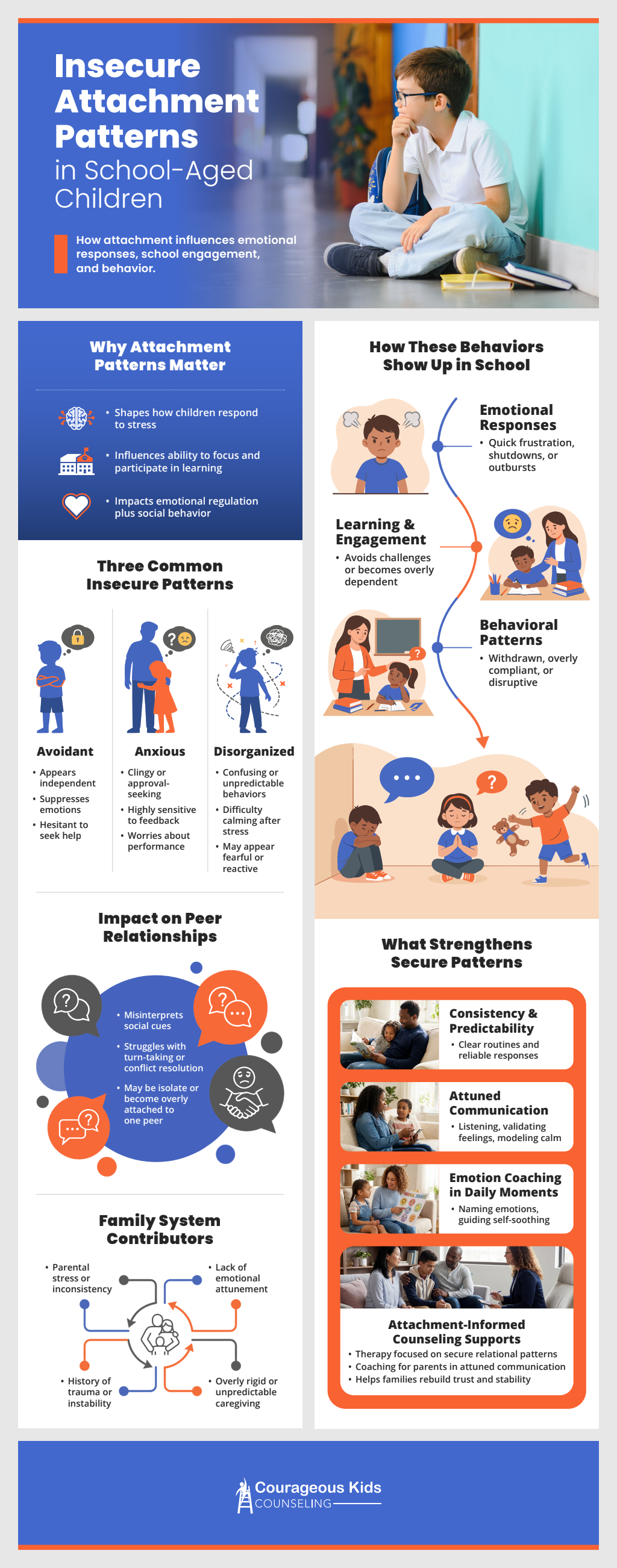
By the time children reach school age, they already carry an internal understanding of how relationships work. Through early experiences with caregivers, they learn whether it feels safe to ask for help, how emotions are received, and what to expect from adults during moments of stress. These early lessons quietly influence how children behave in classrooms, friendships, and learning environments. While attachment patterns may show up in observable ways, their deeper impact is often emotional and unseen.
Insecure attachment patterns typically form in environments that felt inconsistent, overwhelming, or emotionally unclear. This does not mean caregivers failed or did not care. Many caregivers were managing their own stress, limited support, or unresolved experiences. Children are highly adaptive. Some respond by becoming very self-reliant, learning not to depend on others. Others become highly attentive to the emotions and reactions of those around them, hoping to preserve closeness. Some children alternate between these strategies as they attempt to make sense of mixed emotional signals.
These early adaptations often surface once children enter school. A child may struggle to engage in learning because mistakes feel emotionally risky. Another may appear distant or unfocused, not due to a lack of interest, but because so much energy is devoted to feeling secure. Social interactions can feel intense, and peer conflicts may trigger strong emotional reactions. Group activities, transitions, or moments of uncertainty can activate protective behaviors that were formed long before the child could articulate what they were feeling.
Supportive growth occurs when adults respond with steadiness, empathy, and predictability. Creating emotionally safe environments means slowing down, recognizing the feelings beneath behavior, and building connection before offering correction. Small, consistent actions such as explaining what will happen next, offering choices, and acknowledging emotions help rebuild trust. Over time, children begin to internalize new expectations. They learn that adults can be dependable, emotions can be expressed safely, and relationships do not have to feel unpredictable.
Caregivers are an essential part of this process and often need support as well. Exploring attachment patterns can bring awareness to personal stressors, past experiences, and relationship habits. Online therapy for kids offers a space where caregivers and children can reflect, learn, and strengthen their connection together. When both children and caregivers feel supported, relationships grow more secure, and children gain the confidence to engage fully in both learning and social experiences.
If you would like another way to explore how attachment patterns influence children during the school years, please review the related resource provided.